· Reviewed by Dr. Andreas Boettcher, MD
Free vs total testosterone explained by a functional medicine MD. Why the bound vs free distinction matters and what to ask your doctor for.
When men over 40 finally ask their doctor for a testosterone test, they typically get back a single number — total testosterone — and are told it's either "normal" or "low." But that one number leaves out something critical. The body has two forms of testosterone in circulation, and the more biologically active one is rarely measured. Understanding the difference between free and total testosterone explains why some men with "normal" lab results still feel exhausted, gain belly fat, and lose libido — and why supplementing the right way matters.
Total testosterone is exactly what it sounds like — the entire amount of testosterone circulating in your bloodstream at the moment of the blood draw. The reference range for adult men typically falls between 264 and 916 ng/dL, though this varies by lab, age, and time of day (testosterone peaks in the morning and declines through the day). Most doctors consider anything above 300 ng/dL "normal," but that range is so broad it's nearly useless for individual men. A 35-year-old at 320 ng/dL is technically "normal" but functionally low for his age.
Total testosterone counts every molecule of testosterone in the blood — including the portion bound tightly to a transport protein called SHBG (sex hormone binding globulin). This bound testosterone exists in your body but cannot enter cells and produce any of testosterone's biological effects. It's essentially inactive cargo waiting in the bloodstream.
Free testosterone is the small percentage (typically 1-3% of total) that floats freely in the blood, unbound to any protein, ready to enter cells and bind to androgen receptors. This is the testosterone that actually does the work: building muscle, supporting libido, maintaining bone density, regulating mood, and powering the energy you feel through the day.
A man can have a "normal" total testosterone reading of 600 ng/dL but a low free testosterone if his SHBG is elevated. SHBG rises naturally with age, in response to chronic stress, after liver disease, and from certain medications. The result is a man who looks fine on paper but feels like someone in true testosterone deficiency — because biologically, he is.
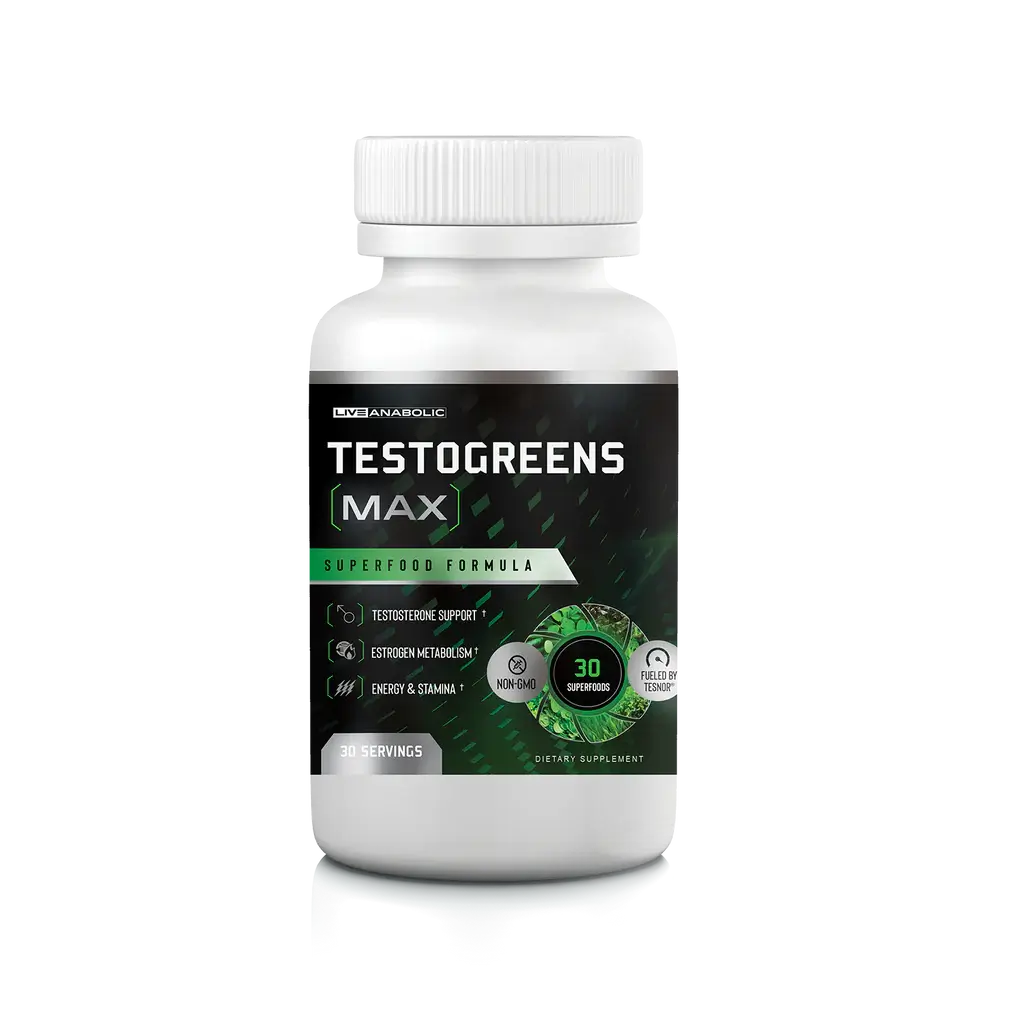
Most generic testosterone boosters claim to raise "testosterone" without distinguishing between free and total. Some increase SHBG along with total testosterone — meaning the new testosterone gets bound up immediately and never reaches the cells. The patented Tesnor compound in TestoGreens Max was specifically studied for its effect on both free and total testosterone in a double-blind placebo-controlled trial. The clinical data showed significant increases in both — the free portion is what actually drives improvements in energy, libido, grip strength, and arm size that users report.
DIM (Diindolylmethane), the second hero ingredient in TestoGreens Max, addresses a related issue: the conversion of testosterone to estrogen via the aromatase enzyme. As men age, more circulating testosterone gets aromatized into estradiol. DIM helps shift estrogen metabolism toward less harmful pathways and supports a better testosterone-to-estrogen ratio. The combined effect: more testosterone produced, more of it stays as testosterone (rather than converting to estrogen), and more of it stays free and bioavailable to do its work.
When you get tested, request a complete hormone panel that includes: total testosterone, free testosterone, SHBG, estradiol, and ideally DHT (dihydrotestosterone). Also ask for the test to be drawn between 7 and 10 AM, when testosterone naturally peaks. A repeat test at the same time of day is more meaningful than a one-off — testosterone fluctuates significantly throughout the day and across days. Two morning readings spaced two weeks apart give a much truer picture than a single afternoon draw.
Here's what most men aren't told: "normal" and "optimal" are different things. The lab's normal range (264-916 ng/dL for total testosterone) is so wide because it includes everyone — the 80-year-old with severe deficiency and the 25-year-old elite athlete. Optimal for an active man over 40 is typically 600-900 ng/dL total and 100-150 pg/mL free. Many men feel symptomatic at 400-500 ng/dL even though their lab report says "normal." This is the gap that natural testosterone-support supplements like TestoGreens Max are designed to address — getting men from "technically normal" to "optimal for vitality."
If your total testosterone is consistently below 300 ng/dL on multiple morning tests, with symptoms like erectile dysfunction, severe fatigue, depression, or significant muscle loss, you have clinically low testosterone (hypogonadism) and should consult an endocrinologist about TRT. Natural supplements like TestoGreens Max are designed for the much larger group of men in the 350-500 ng/dL range — the "low-normal" zone where lifestyle and supplementation can genuinely move the needle. For men in this range, the three-pronged approach of Tesnor (boost) + DIM (preserve) + Bioperine (absorb) offers a meaningful natural path before considering pharmaceutical intervention.
For symptomatic men, low free testosterone is the more biologically meaningful number. You can have "normal" total testosterone but still feel deficient if your free testosterone is low. The free portion is what actually enters cells and produces effects. If your symptoms (fatigue, low libido, poor recovery, brain fog) match low T but your total reads normal, ask specifically for free T and SHBG measurement — high SHBG is a common explanation for the disconnect between "normal" labs and real symptoms.
Yes — but only certain ones. The patented Tesnor compound in TestoGreens Max was specifically measured for both free and total testosterone in clinical trials, with significant increases in both. Compounds that lower SHBG (like boron) increase free testosterone even without changing total. Generic testosterone boosters that raise total without addressing SHBG often produce minimal real-world benefit because the new testosterone gets bound up immediately.
Subjective improvements (energy, libido) often appear within 2-3 weeks as bioavailable testosterone rises. Measurable bloodwork changes typically take 6-12 weeks of consistent daily supplementation. The 6-bottle TestoGreens Max bundle is sized for this evaluation window. Test before starting and again at 90 days for the most useful comparison.
Money-back guarantee on the Live Anabolic LLC Official Website.
Visit TestoGreens Max Official Website →Total testosterone is the entire amount of testosterone in your bloodstream. Free testosterone is the biologically active portion not bound to SHBG (sex hormone binding globulin) — typically 1-3% of total. Free testosterone is what actually enters cells and produces effects.
Elevated SHBG can bind too much of your total testosterone, leaving inadequate free testosterone available to produce effects. This is why a complete hormone panel must include both free testosterone and SHBG, not just total testosterone.
Aging, chronic stress, low protein intake, low calorie intake, and certain medications all raise SHBG. Some men have genetically high SHBG. Practical interventions include adequate protein, magnesium, boron, and reducing chronic stress.
Functional medicine practitioners often cite 100-150 pg/mL of free testosterone as the optimal range for vitality and symptom relief. Below 70 pg/mL of free testosterone is generally associated with symptoms even when total testosterone reads as normal.
Both. Total testosterone alone can miss free testosterone deficiency in men with elevated SHBG. The minimum useful panel is total testosterone, free testosterone, SHBG, and estradiol — all drawn between 7 and 10 AM.